what shapes should kindergartners be able to name according to common core standards
Call up the shape puzzles your kid toyed with — using triangles to make squares and rectangles? Turns out, that was skilful practice for get-go class math.
Past the terminate of commencement form, here are the 11 math skills your kid should learn:
- Counting to 120 — starting anywhere, like from 3 or 72.
- Calculation and subtracting numbers up to xx.
- Knowing that this sign "=" ways equal.
- Solving word problems with three one-digit numbers (due east.g. 2 + 3 + 9) that add up to 20 or fewer.
- Understanding why improver and subtraction are the reverse of each other.
- Adding up to 100, including calculation a 2-digit number and a one-digit number (eastward.g. 82 + vii).
- Knowing how to add two-digit numbers based on place value.
- Adding or subtracting x using mental math (e.g. 31 plus 10 is 41).
- Starting to mensurate things, such equally figuring out how many of his footprints tin can fit into his dad's footprint.
- Telling and writing fourth dimension to the hr and half-hour (e.g. 1:00 pm and 1:30 pm).
- Putting 2 shapes together to create a new shape, and dividing shapes into ii and four parts.
I'll take math for 120, please
Counting to 100 — that's for kindergartners. Get-go graders count to 120, just the take hold of is that they can start from any number, similar 72, and count upward to 73, 74, 75, and so on. Kids also larn to subtract numbers upwardly to xx, like 19 – 7 = 12. Students learn to solve word issues using objects, drawings, and, aye, even equations. For instance, if Ted has 4 pencils, Danielle has 6 pencils, and Vicki has 9 pencils, how many pencils practice they have all together?
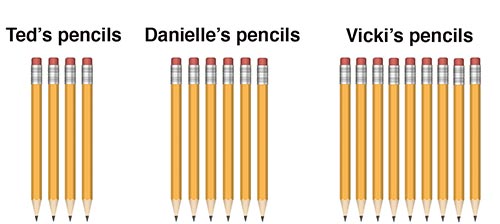
Your get-go grader may first draw this problem and count the pencils, but by the end of the year she'll know the equation — and how to solve information technology.
Outset graders also acquire the relationship between counting, add-on, and subtraction. For example, counting from 1 to 2 is the same as adding 1 + ane. Calculation 1 more means counting upward one, and adding two more than means counting upwardly two, and and so on. Likewise, subtraction tin be thought of as counting down or astern. Taking that a step further, kids learn to call up of subtracting as the reverse or "undoing" of adding. And then, for instance, if fifteen + 4 = 19, then 19 – 4 = fifteen.
Everything in its place
In kindergarten, your child started to learn almost identify value using tens and ones. In a two-digit number like 19, the 1 represents the tens and the 9 represents the ones. Now, your first grader will build on that by learning to add a 2-digit number, like 54, and a 1-digit number, like 5, or two-digit number that's a multiple of 10, like x, twenty, 30, 40, etc.
One strategy your child will acquire is to add together the tens and ones separately.
For case: 54 + 5 = 50 + 0 = l and four + v = 9 for a total of 59.
And sometimes, it's necessary to create a ten from the ones.
For example: 54 + 7 = 50 + 0 = l and iv + 7 = 10 + 1. Move the 10 to the tens, and then information technology's 50 + 10 = threescore and 1 for a total of 61.
Your child will also be expected to effigy out in her caput — without counting — how to notice 10 more or less than another number. If Jemma has 68 lollipops and gives away 10, she should know that's the aforementioned as subtracting one grouping of tens, leaving her with 58 lollipops.
How does this measure up?
First graders should be able to explicate how long two objects are by comparing them to a 3rd object. For example, the first slice of newspaper is shorter than the second piece, but longer than the third.
Kids start applying the concept of addition to measuring things. Let's say your kid uses the canis familiaris'due south tail to measure the length of a coating; he might detect that the blanket is v-and-a-one-half tails long. This is great practise for when the kids start using rulers.
Start graders also learn to tell time (and write information technology down correctly, like i:thirty pm) to the nearest hour and half-hour past reading both digital clocks and the onetime-fashioned circular clocks with infinitesimal and hour hands.
Getting into shapes
First graders delve into the properties of shapes past combining ii shapes to form a new one, such as putting two triangles together to make a square or rectangle. They'll practise this on newspaper (2 dimensional) and with objects (3 dimensional).
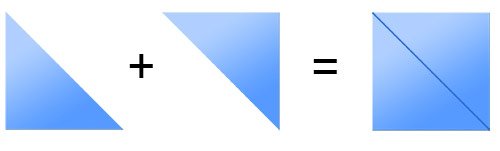
Kids as well learn to split shapes into or two or four equal parts and learn the words for those parts: halves and quarters (or fourths).
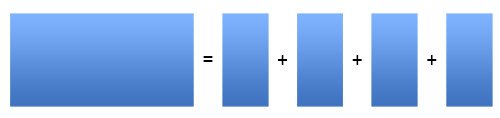
Then intermission out the blocks and Legos and have a boom while yous can yet practice all of your child'due south math skills at home while playing on the flooring.
• See what knowing the ones and tens places looks like in this first grade math Milestones video.
• Can your first grader solve a word trouble like this?
Updated: December 2, 2019
Source: https://www.greatschools.org/gk/articles/first-grade-math-under-common-core-standards/
0 Response to "what shapes should kindergartners be able to name according to common core standards"
Post a Comment