how to draw a 3d hallway step by step
It is not hard to apply a elementary or procedural material to an object. But it becomes much more than complicated when the surface needs a certain texture displayed on it. Whatsoever texture map is put in the Lengthened slot of the material, but the results of rendering may be unpredictable. That's why we demand to acquire how 3DS MAX applies textures to 3D objects, what UVW Map is, and why you should "unwrap" it.
This article is written for those who are learning 3DS MAX, but already know the basics: interface, modeling, modifiers, and materials. This is a step-by-step tutorial: nosotros won't explain what all the buttons are for, just will show the ones most commonly used.
Permit'south showtime with a simple model of a dinner table. Its geometric shape volition help the states learn the standard tools. You can use any simple box or cylinder-shaped model to become clear and like shooting fish in a barrel to see results. Assign a simple cloth to it – depending on your rendering engine or cloud render farm yous use, information technology can be Standard, VRayMtl, or CoronaMtl. Add together a Bitmap to the Diffuse slot and apply a texture (yous tin too drag-and-drop the texture into the slot). In our case, we downloaded a gratuitous wood texture from Arroway Textures. In the Bitmap's settings, click the "Show Shaded Textile in Viewport" checkbox, and the texture will become visible.
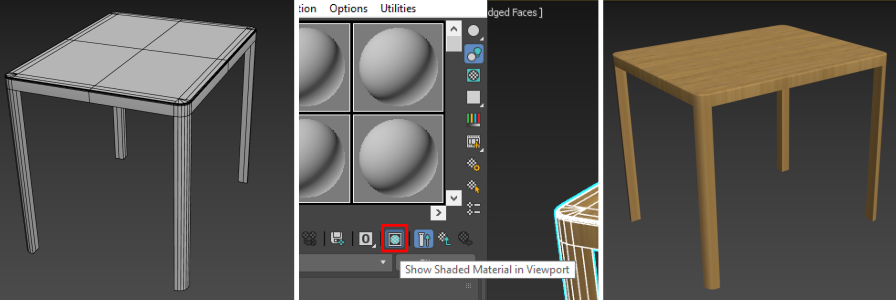
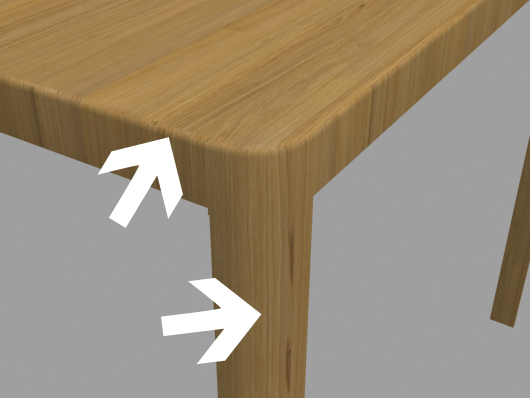
The texture is obviously also stretched and doesn't display properly on the sides and legs. By default, 3DS MAX tries to project the texture on a 3D object as if information technology was a elementary plane, and then stretches the pixels on the edges for the summit. To ascertain how to properly display our texture, we demand a UV Map.
3D software "unfolds" the 3D object onto a plainly surface and so links each pixel with a matching pixel on the texture. The process of linking these pixels together is chosen UV mapping. In 3DS MAX, this is done through the UVW Map and Unwrap UVW modifiers. After that y'all are prepare to use 3ds Max return farm to render your project.
UVW Map: for simple shapes and objects
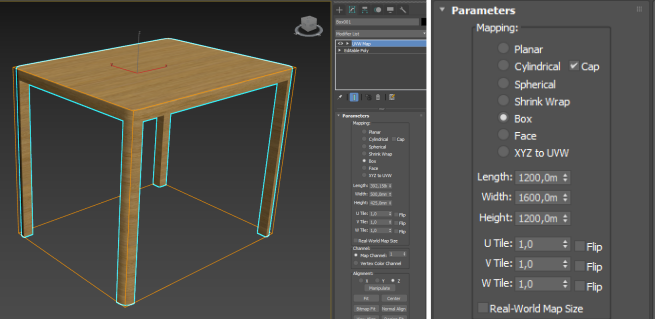
Apply UVW Map modifier to the object. Length, Width and Meridian values control the size of the Gizmo of the texture project. When using square seamless textures ,nosotros can enter the size of the materials shown on the texture. It is easier when our material has certain elements for which nosotros know the sizes (due east.g. flooring boards, bricks). This way, the size of the texture is calculated by multiplying the width/length of a single element by the number of elements. Otherwise, you have to approximate or approximate the suitable values. Our texture'southward size is 1200 x 1600 pixels, and nosotros don't know the size of the cloth on it in millimeters (our system units). Let's try putting these values in Gizmo sizes – 1200 ten 1600 x 1200 mm. The effect is skilful enough for our case. When guessing the values, make sure to continue the attribute ratio between dimensions constant.
NOTE: if you are using existing materials from Corona Material Library or VRay Material Library, cheque the "Real-World Map Size" checkbox in UVW Map preferences. Texture sizes are already built into these materials, then y'all don't have to guess them.
Our texture looks much ameliorate at present, simply information technology is rotated the wrong fashion on the table legs. The rotation of the texture is controlled by the object's Gizmo; to change it, open the modifier's whorl and select information technology. Yous can move, rotate, or calibration the Gizmo like a normal object. Utilise the Angle Snap tool to turn Gizmo xc degrees past one of the axes (10 or Y, depending on your object).
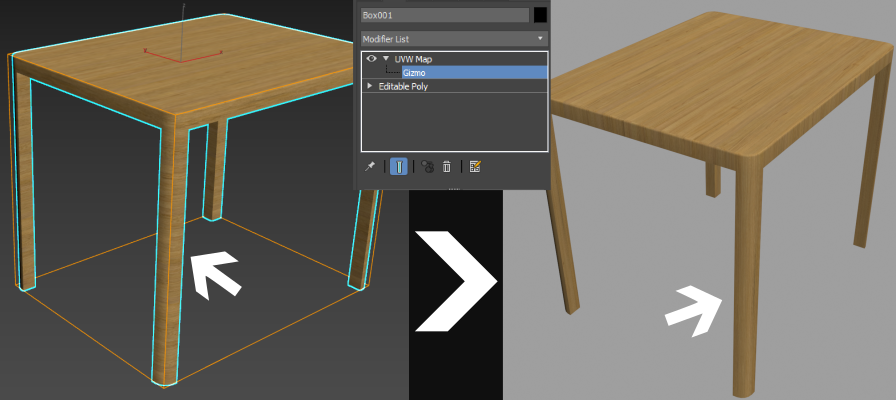
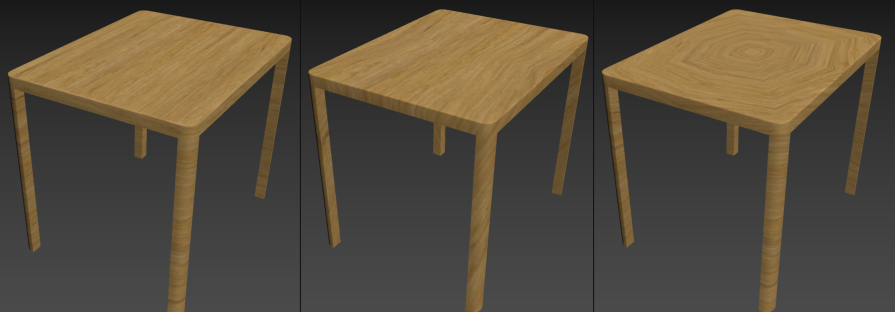
This is a good result for an object in the background, or away from the focus of the shot. Attempt choosing different UVW Map types to see which one fits your object best. For example, here's how our table would look like if we use Cylinder, Shrink Wrap or Sphere projections.
Unwrap UVW: changing a UV map manually
Our table has a simple shape, but the texture still doesn't look perfect subsequently applying UVW Map. There is a seam in the middle of the leg, which will become more visible once we change the texture. The imperfections will be even more noticeable if nosotros assign UVW Map to an object with many elements that don't fit standard gizmos. In this case, nosotros need to utilize Unwrap UVW modifier instead.
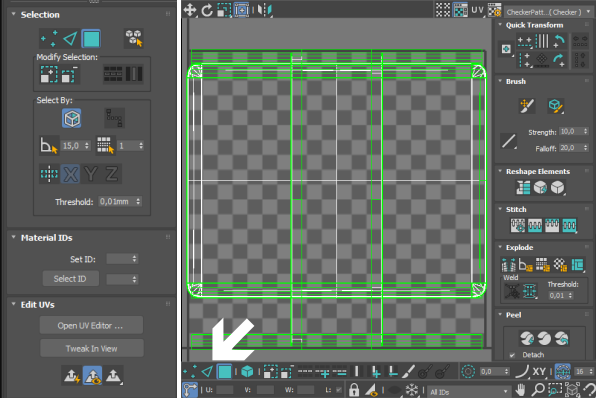
Unwrap UVW has many tools for creating and editing the UV maps, and figuring out how it works is not that piece of cake. Outset, let's click the Open up UV Editor button; here we can see our current map. This i was created by UVW Map modifier practical right before Unwrap UVW. The map will be empty if the object was not created through basic primitives.
The elements of a UV map can be interacted with through Vertices, Edges and Faces, the same as in Edit Poly. If you pick a face on the UV Map, it will become highlighted in the viewport, and vice-versa. To select the whole UV Map element, apply the "Select Past Element UV" toggle switch, located next to the Faces icon. This can exist used with any selection style.
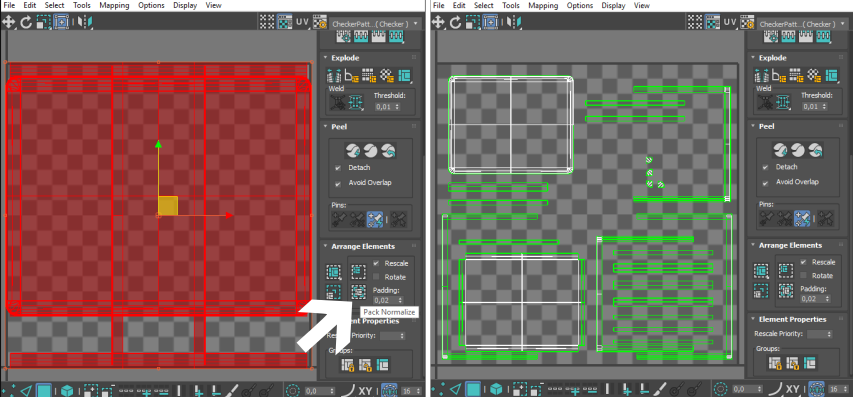
Correct now, all of the map elements are stacked on summit of each other, and it is hard to figure out which is which. Select all the polygons (Ctrl+A or through area selection) and click "Pack Normalize". The elements are now spread out on the whole map, and we can edit each separately.
Try clicking unlike polygons to run across them highlighted in the viewport. Y'all tin come across that the tabular array legs are divided into several elements, which is why we meet a seam there. Let'due south sew them together. Pick an edge in the center – it will be highlighted in ruby, while the adjacent i will become blue. Right-click the highlighted edge and select Stitch Selected. The elements will connect, the edges will become one and the seam will disappear.
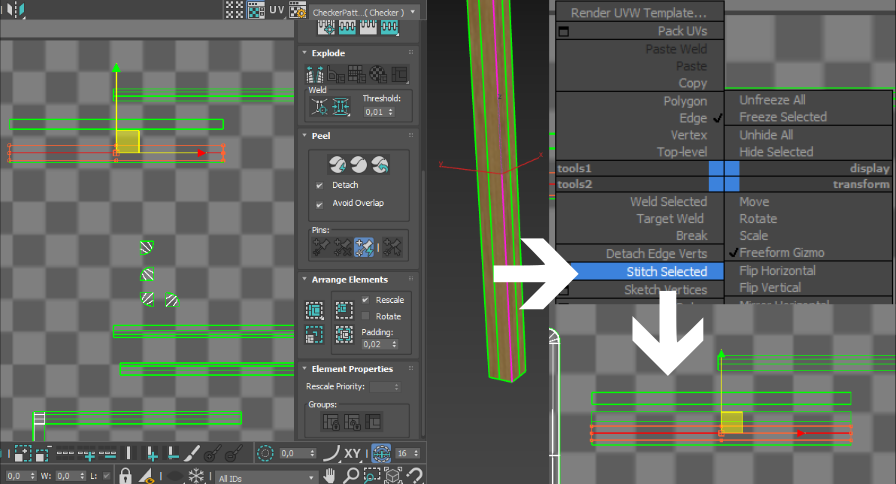
Keep stitching the edges together wherever you lot want to remove the seams. It's not ever possible, and sometimes you may make a wrong determination. If the unwrapping didn't turn out that well and you lot can no longer undo it, just delete the modifier and start over. In our example, nosotros left the lesser of the tabular array split from the top, and stitched together the sides and legs of the table in two parts.
Afterward the elements are stitched together, select all the polygons again and click Pack: Custom. At present the elements are packed together, without intersecting, and fit neatly into the texture. However, we want to run into our wood texture instead of checkers, so let's select it in the top-right corner menu. Ideally, you'd use a seamless texture – this way you lot can scale all the texture elements outside the bounding box to set the proper size. In our case, the result is good enough.
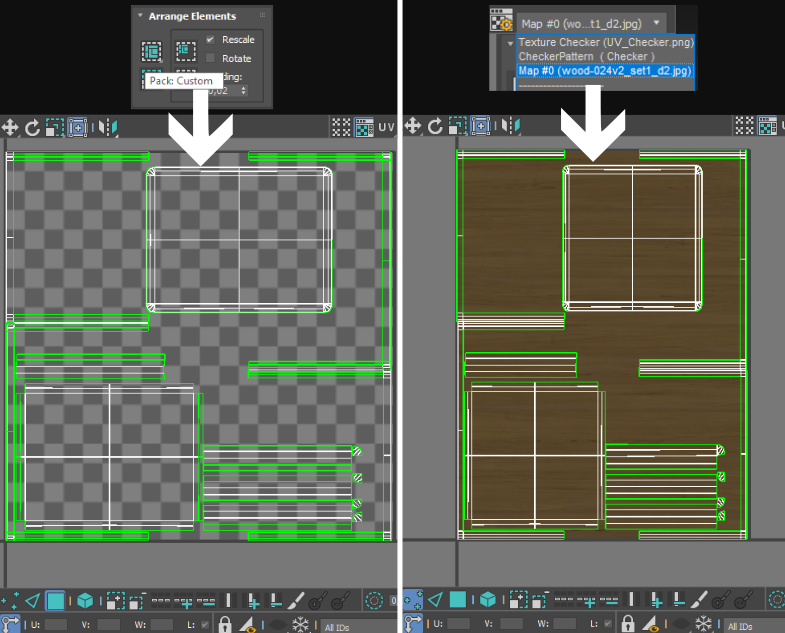
Here is our consequence so far:
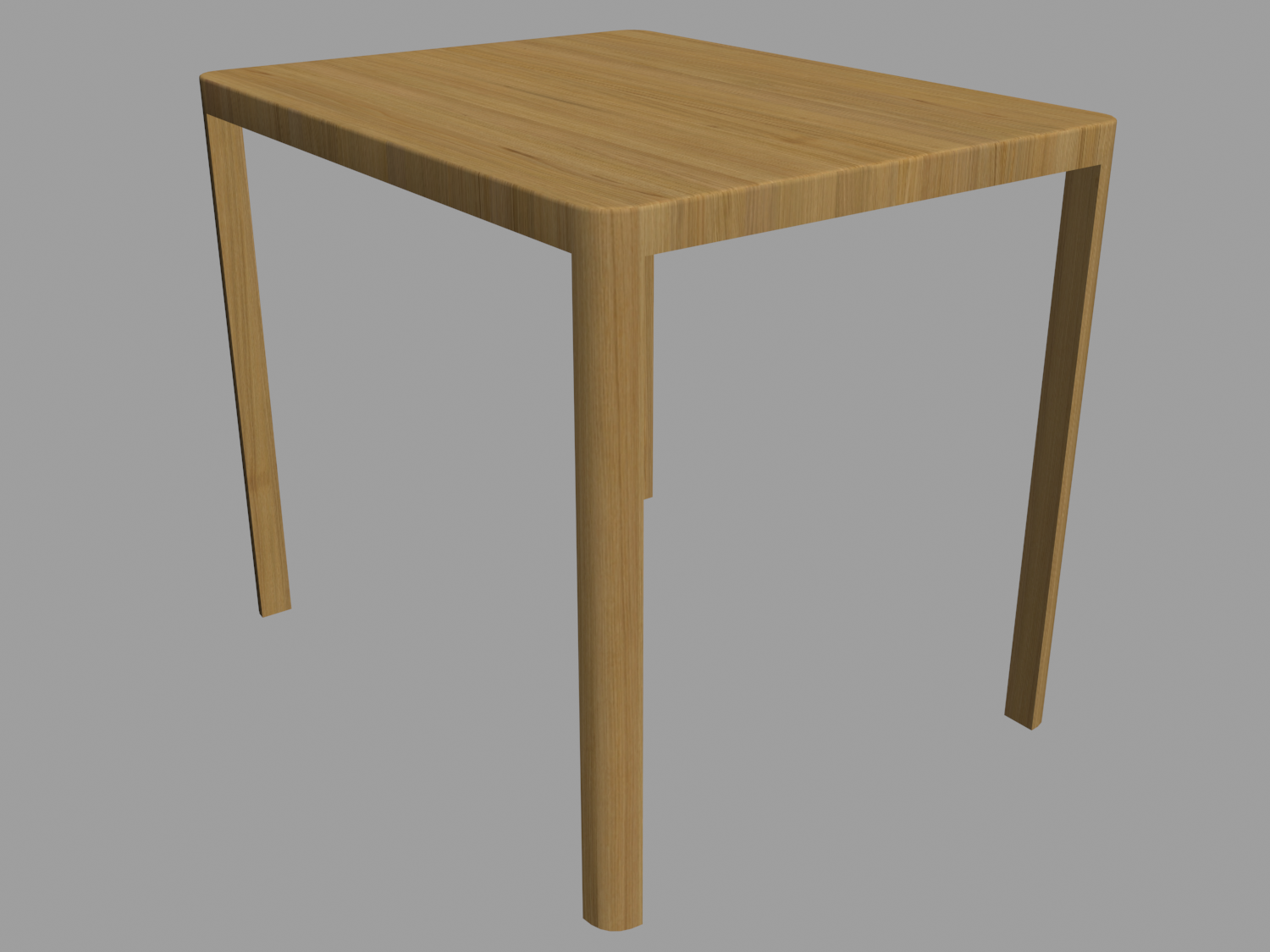
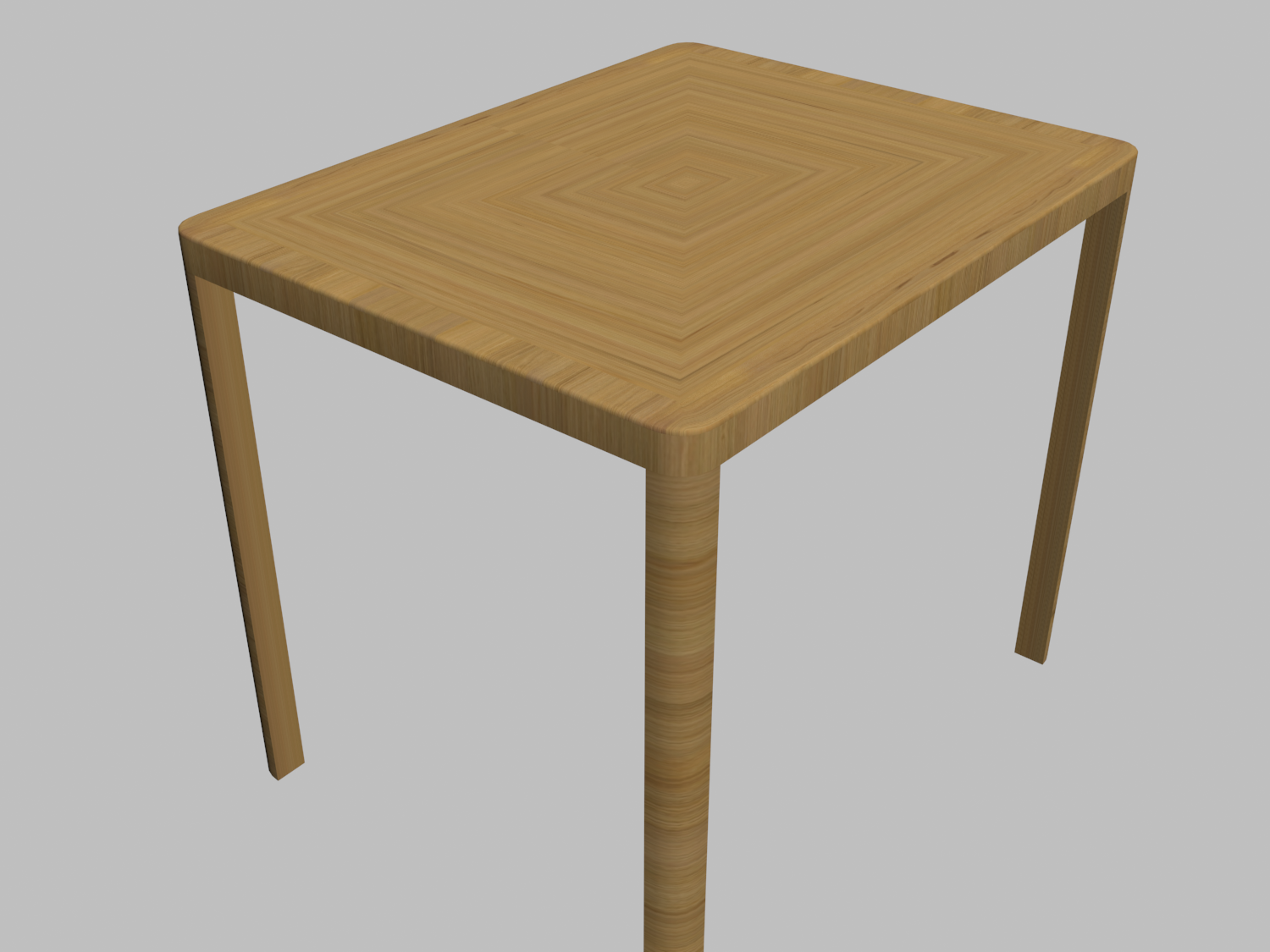
Annotation: You tin create an interesting cloth layout by using several UVW Map modifiers for unlike faces selected in Edit Poly. For example, this is what you can get past applying Cylinder gizmo to table legs, box to the sides, and sphere to the top surface.
Unwrap UVW: creating a UV map from scratch
Information technology'south not productive to offset stitching elements manually when y'all have a circuitous object. UVW Map modifier doesn't work well with shapes outside the primitives: information technology creates seams in the heart of the elements, cuts them in unexpected places, and complicates the already painstaking work. Standard Unwrap UWV tools commonly separate an object into too many elements (effort using Tools → Flatten Mapping to meet an example). In such cases, it is easier to cut your own seams.
Lets have a depression-poly model of this creature, which nosotros are going to telephone call Crabby. Utilize checker texture to it using UVW Map with a Sphere gizmo.
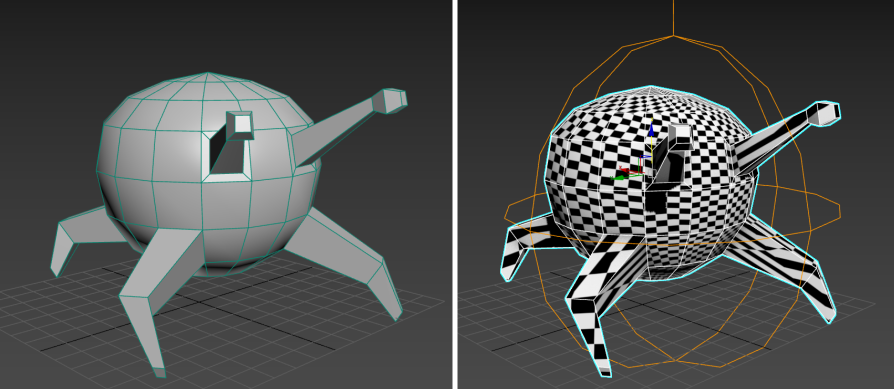
The texture is all stretched on Crabby's legs and eyes because these elements don't fit into the sphere. It is better to texture them separately from the residual of the trunk. Utilize Unwrap UVW to meet green stitches in the viewport created by UVW Map. We don't need them, so permit's click Reset Skin to clear the UV map.
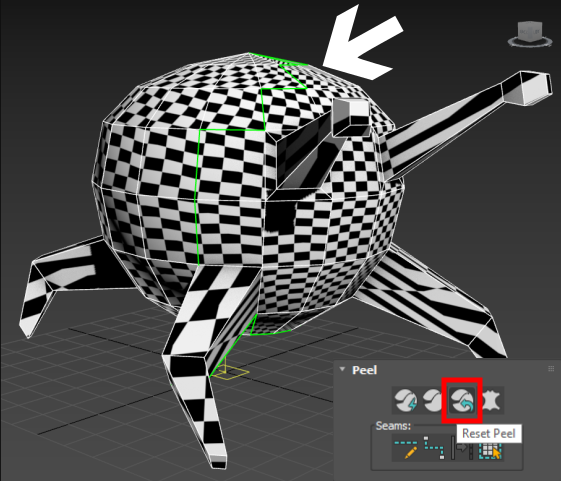
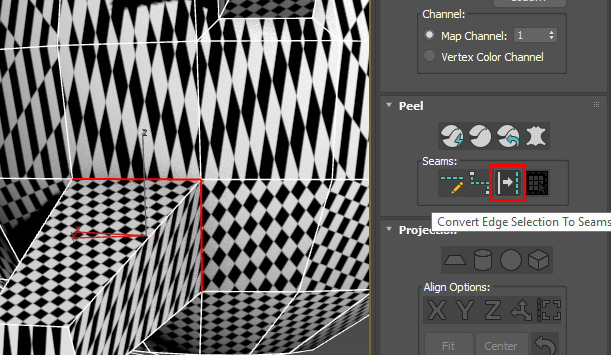
Now let's create new stitches. Option the edges y'all want to become stitches and click Convert Border Selection to Seam. Make the seams run around each leg and center stem, on Crabby'southward belly and back. You may accept trouble figuring out the right identify to cut at offset, but don't give up. Remember the Reset Peel tool if yous don't like your result and would rather start over.
Our seams look like this:
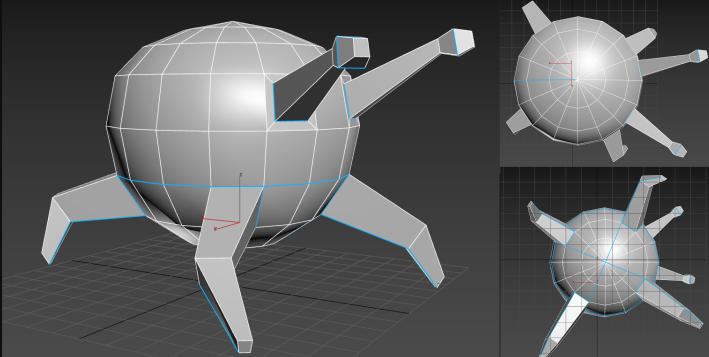
Note: To learn how to correctly cut complicated 3D models into patches for unwrapping, you'll have to practice a lot. Think near texturing when yous are modeling your object and pay attending to places where you'll be able to run stitches through later. Unwrap low-poly models: it means you will have less polygons to worry about; the UV Map will piece of work simply fine after applying Turbosmooth.
Later marking all the seams, choose a polygon on the surface and click Expand Polygon Selection to Seams. It selects a whole element limited by our new seams. With this selection, click Quick Peel – and you lot'll create a UV map of this element. Y'all can pick all the elements at once and the UV map will be created for all of them, but we are trying to make sure we accept made enough seams, so permit's repeat these deportment for each element separately. Turns out we need one more seam for the eye stalks, otherwise the unwrapped chemical element gets deformed. Undo the unwrapping, create a new seam, and try again.
All the elements are at present unwrapped, but they are obviously not scaled properly. Select all the faces and click Rescale Elements to set up it.
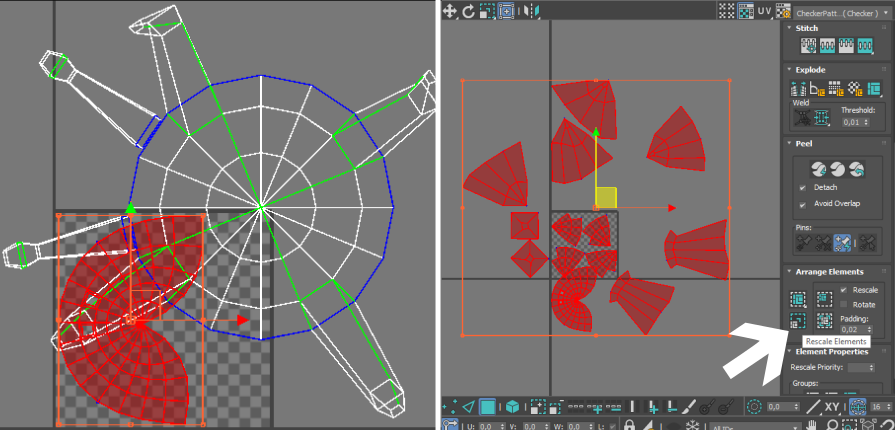
The faces on Crabby's body wait also stretched on the edges. Select the element, open the Tools menu, and choose Relax. Click Beginning Relax – the faces gradually outset changing their shapes and locations to fit the original model better. When it starts looking good, click Stop Relax and Utilise. If the UV map contains knots and overstretched polygons, use higher values of Stretch and Amount – this will fasten the relax process. Apply Relax to all the other elements of our map for practice.
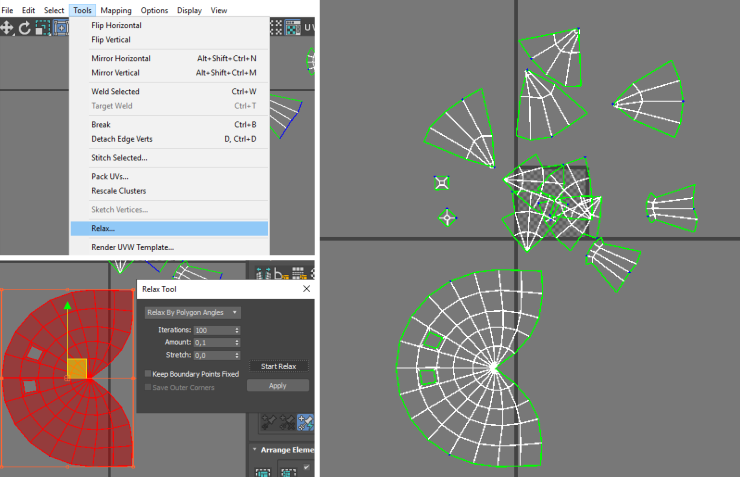
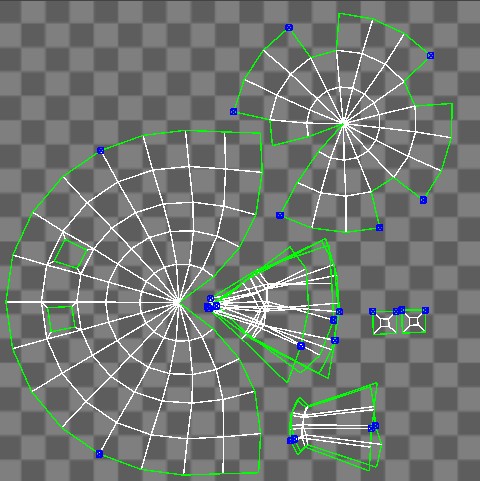
The terminal UV Map should fit into the texture, so select all the faces and click Pack: Custom. Some of the elements that don't need unique textures can be put one on top of the other to save space. Let'southward pack together Crabby's legs and eye stalks, but leave the eyes divide to afterward colour them with unlike shades. Think that you lot can motion and rotate elements to make them fit together better. But if you want to scale them, do it for all the elements simultaneously, or they'll lose relative proportions.
Turns out we made as well many seams on Crabby's belly, and so let'southward run up them together through Stitch Selected. Our final UV map looks like this:
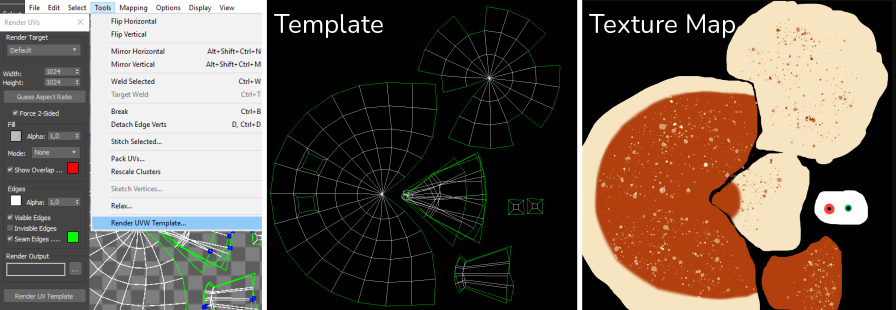
To describe our texture, permit's export this map. In the Tools carte du jour, choose Render UVW Template. Yous can set the image size, color, and thickness of the lines in the opened window. Click Render UV Template and salvage the image in whichever format you like all-time. Now nosotros tin depict a texture for Crabby in any drawing application.
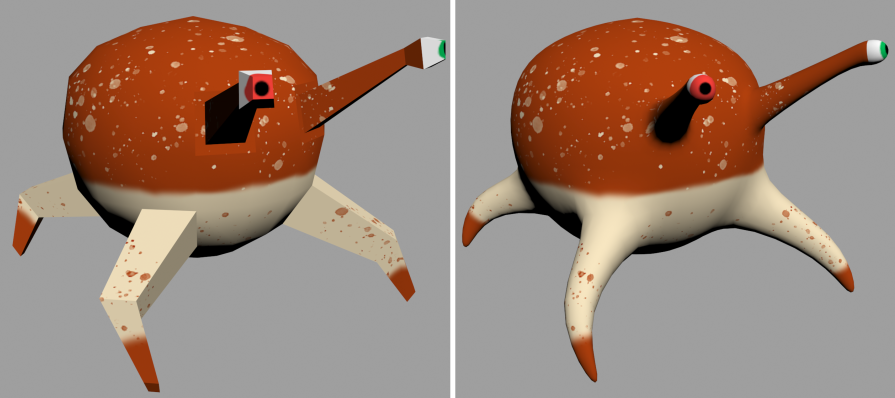
Create a new material with this map in the Diffuse slot and utilize it to the model. Crabby is finished! The UV map works for both low-poly and loftier-poly models.
In this tutorial, we've learned how to create UV maps in 3 different ways. In practice, they can be used all together or separately. Every 3D creative person or studio develops their own pipeline for unwrapping. Practice and experiment more than to find the workflow that suits you lot the best. Practiced luck!
Source: https://megarender.com/blog/uvw-map-and-unwrap-uvw-a-step-by-step-guide/
0 Response to "how to draw a 3d hallway step by step"
Post a Comment